

How do you find out what an agent doesn’t know?
How do you identify gaps in an AI agent’s knowledge when you don’t have ground truth about what it should have known? We built a gap finder that combines investigation traces, statistical testing, and live environment exploration to identify missing knowledge and prioritize the gaps worth fixing.
How we made evals 100× cheaper with multi-agent architecture

When our evals became too expensive and slow to run, we rearchitected our single investigation agent into a team of ~40 loosely coupled agents. While there are some tradeoffs, it’s made evals run 5x faster for cents on the dollar, and we can experiment much more rapidly to evolve our product.

Jev the Decider: JIT for Agents

Constraining action spaces for faster, cheaper agents

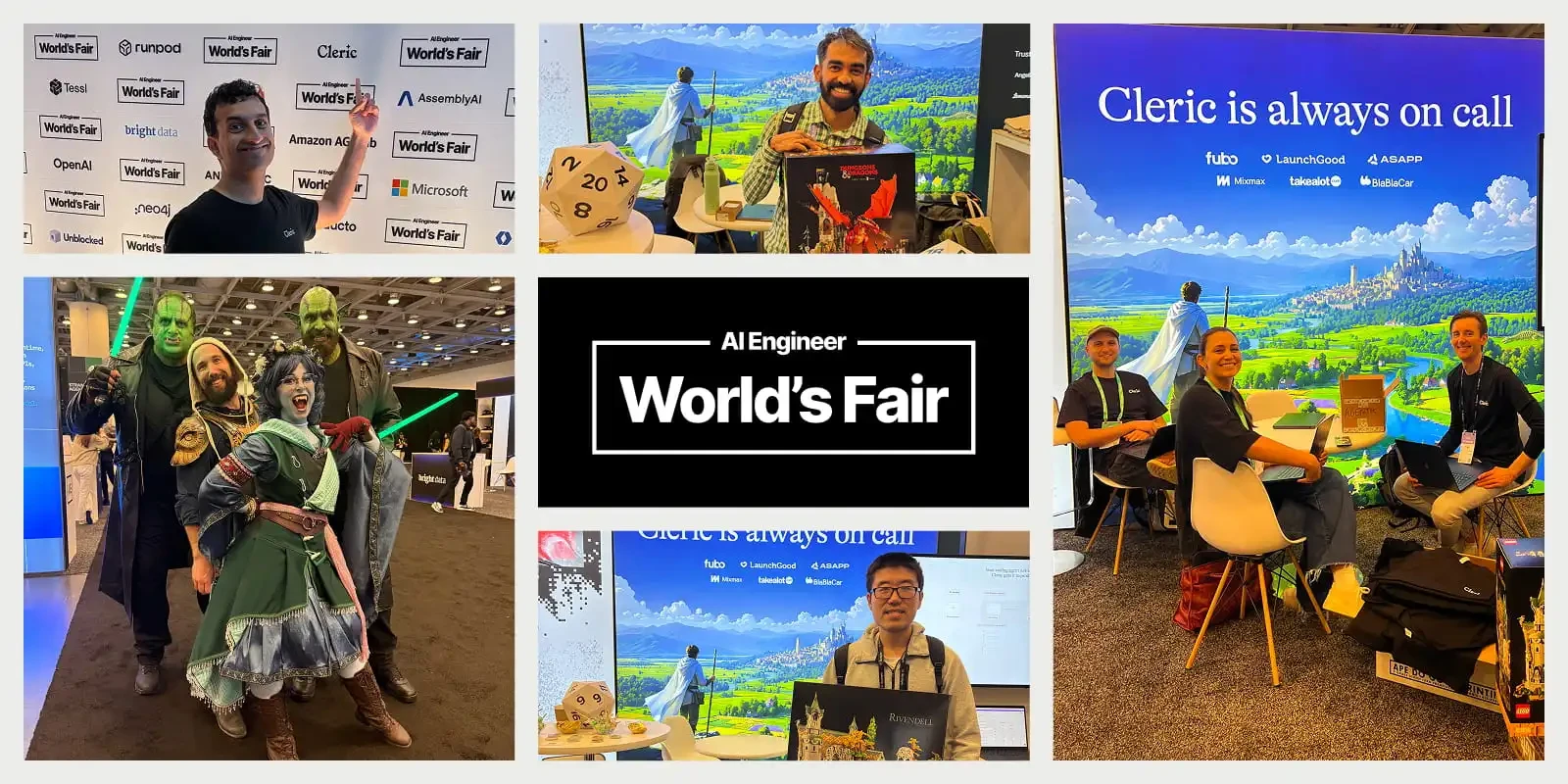
Roll for initiative: our week at AI Engineer World’s Fair 2026

Everyone knows agents can write code, but the open question is what happens after the code is merged.
Our LLM judge scored worse than chance until we made it compare
We rank an agent’s investigation traces by comparing them in pairs and turning the wins into an Elo score. Grading each trace on its own scored worse than chance. Comparison made the ranking work, and it catches regressions our other evals miss.

How we verify Cleric’s production fixes
A correct diagnosis isn’t the same as a fixed problem. We built a verifier that checks Cleric’s fixes against the best ground truth available: production itself.

You’re renting your institutional knowledge

Most AI agents rent knowledge back through forward-deployed engineers. The ones worth buying compound verified memory in systems you own.

How Cleric uses Tailscale to securely automate software operations
An AI SRE has to access the same private resources a human engineer would. We use Tailscale to get there.

Stop Reviewing Agent Output. Start Reviewing Agent Decisions.
When agents can produce anything, the bottleneck shifts from code to judgment. You manage that by reading the decisions, not the outputs.

Why Your AI SRE Needs Memory
Investigation logic is becoming a commodity. What won’t commoditize is operational memory: the ability to capture and persist engineering judgment.

Hooks Won’t Secure Your AI Agent
AI Agents require strict network controls in order to keep the data they handle secure.


Subscribe to The Tavern
Cleric’s newsletter, featuring new articles on AI SRE and lessons from building Cleric.
By subscribing you agree to our Privacy Policy .